
Primary Sources
 Printer-friendly version
Primary Sources
Teachers, need a primary source to create a lesson in the classroom? Students, need a source for a research project?
Here, we've listed the primary sources featured in our Unit Plans. Click on a primary source to go to its page, where you may find additional images, transcriptions of the text, a citation guide for including the source in a bibliography, or ways to purchase copies of the source for the classroom.
HSP's collections are not limited to the primary sources listed here. To see all that HSP has to offer, come visit us or explore our collection online through the Digitial Library and the Discover online catalog.
Some sources have handwriting that is difficult to read. If you need help decoding handwriting, check out this guide from Ancestry.
 A Liberty Loan poster depicting a wounded soldier in the hospital writing a letter home. Text describes what the soldier has sacrificed for those at home and pleads for Americans to buy Liberty Bonds. Published by the Liberty Loan Committee, Third Federal Reserve District, Philadelphia. |
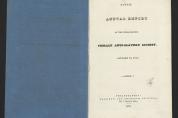 Item is the Fifth Annual Report of the Philadelphia Female Anti-Slavery Society published in 1839 by Merrihew and Thompson of Philadelphia, Pennsylvania. The final page includes a list of officers for 1839 which has been edited in pencil. President Sarah Pugh, Vice President Huldah Justice, Recording Secretary Anna M. Hopper (edited to read Susan Haydon?), Corresponding Secretary Mary Grew, Treasurer Catharine Shoye (edited to read Elizabeth J. |
 Seal of the Philadelphia Female Anti-Slavery Society. The Society was organized in 1833 by Quaker Abolitionist Lucretia Mott at 107 North 5th Street. From its inception, the Society was interracial and its members included African-American businessman James Forten's three daughters. The Society lobbied for the emancipation of enslaved blacks and supported the efforts of the Underground Railroad by providing housing, protection, and transportation to escaped slaves. |
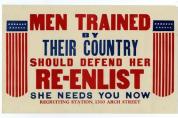 World War I-era recruitment poster targeting veterans. The Arch Street Recruiting Station sought veterans to re-enlist during World War I, asking them to defend their country because "she needs you now." |
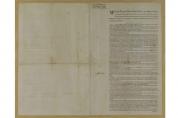 This draft, printed by Dunlap and Claypoole, is the second draft of the Constitution, printed for use of members of the Constitutional Convention. Broom was a delegate to the Convention from Delaware. This second draft no longer lists states separately, but rather as “We, the People of the United States…” |
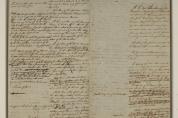 This is the first draft of the Constitution written and signed by James Wilson, delegate to the Constitutional Convention from York, PA, and chair of the Committee of Detail. The committee was charged to draft the Constitution. The earliest surviving version of the Constitution, it consists of four sheets. One unique features is that it lists all of the states in the first line. Also, it states “The stile of the government shall be the ‘United People and States of America. |
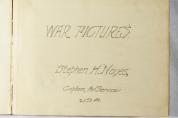 Photo album of Capatin Stephen H. Noyes from his time as a reconnaissance aviator for the United States during World War I. |
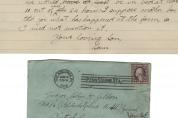 Letter from Sam Gibbon to his father serving as an army doctor in World War I. Postmarked January 14th 1918. |
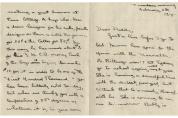 Letter from Marjorie Gibbon to her father serving as an army doctor in World War I. Postmarked February 6th 1918. |
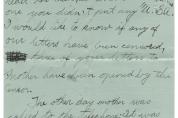 Letter from Sam Gibbon to his father serving as an army doctor in World War I. Postmarked July 23rd 1917 |
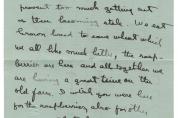 Letter from Jack Gibbon to his father serving as an army doctor in World War I. Postmarked July 11th 1917 |
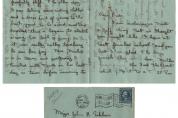 Letter from Marjorie Gibbon to her father serving as an army doctor in World War I. Postmarked June 6th 1917 |
- ‹ previous
- 3 of 22
- next ›